

Traveling the world using points and miles, whether flying first class and staying in luxury hotels or even taking more modest trips, sounds too good to be true, but it is completely real. We have been doing it for over 5 years.
The funny thing is that the key to efficiently accumulating hundreds of thousands of points and miles is not in traveling frequently, nor in being loyal to an airline or a hotel chain, but rather in how we use credit cards.
Traveling with credit card points has been a common practice for decades in the United States, especially among Anglo-Saxons, but even though we are millions of Hispanics living in this country or with access to its credit system without even living there, it is still a very little-known concept for Hispanics, leaving thousands of travel opportunities on the table.
But to take full advantage of this system, it is necessary to have sufficient knowledge, implement proven strategies, and not be swayed by myths.
In this guide, we will teach you the basics and the first steps so that you too can start traveling almost for free using credit cards and rewards programs.
The Basics
The process of accumulating points and starting to travel with points can be summarized quite simply:
1️⃣ Apply for a credit card that generates travel rewards
2️⃣ Meet the minimum spend required to earn the welcome bonus
3️⃣ Use the generated rewards to travel
Done! Pretty simple, right?
The issue is that there is a lot to break down here because there is an endless number of details in the process that are usually confusing at first, but once we understand the basics, everything starts to take shape.
Generating Points: Welcome Bonuses
Welcome bonuses are the star of this hobby. They offer the easiest, most direct, and cheapest way to generate hundreds of thousands of points for travel, though it is not the only way. This is how they work:
Often, credit cards offer a welcome bonus upon approval and upon spending a certain amount of money within a specific timeframe with it. It is usually something like: “60,000 points after spending $4,000 in 3 months from account opening.”
Depending on the type of points we are generating, these 60,000 points can have a value of $600 in cash or for travel, although sometimes they can be worth much more, perhaps $1,200 or $1,800, for example. It all depends on the type of points generated and how they are redeemed. There are many ways to do it, and not all points are created equal.
The $4,000 spend you need to make is what is known as the minimum spend requirement. Once you have spent that amount within the required timeframe, you are awarded the bonus, you can redeem them for flights and/or hotel stays, and that's it! You are traveling without spending out of pocket.
Keep in mind that many cards occasionally offer "elevated offers" on their welcome bonuses. For example, instead of offering 60,000 points for spending $4,000 in 3 months, the offer is 70,000 points. On the blog, you'll find the best travel cards with their respective current offers, and we also publish elevated offers from other cards that are worth mentioning.
Is it really free travel?
Now, you might think… I'm not spending on my trip, but I had to spend $4,000 in 3 months to get those points, so I am indeed spending!
And yes, you are absolutely right. It is necessary to spend to get points on credit cards. The detail here is that we all have expenses in our day-to-day lives (unless a child is reading this, in which case, show it to your parents), so the idea is to use credit cards for our daily expenses without spending more than we had already budgeted, then pay off the card in full to avoid paying interest, and benefit from the points generated.
If a credit card requires spending $4,000 in 3 months to get a 60,000-point bonus, this equates to a monthly spend of approximately $1,333.
Category | Average Monthly Spend |
|---|---|
🛒 Groceries | $400 |
Gasoline | $150 |
🏥 Insurance | $700 |
Medical | $150 |
💊 Pharmacies | $40 |
📖 Education | $300 |
🧴 Personal Care | $100 |
Restaurants | $300 |
🍿 Entertainment | $200 |
✈️ Travel | $300 (annualized) |
As we can see, the average person spends much more than $1,333 a month. We could even organize ourselves to pay for a large expense all at once, like an annual insurance policy, and earn a welcome bonus in the process.
So, if we are spending what we would spend anyway, regardless of whether we pay with one card or another, or even cash, we could say that the trips we take with credit card points are practically free.

Getting to know Prague without spending on accommodation thanks to points and miles 🤩
How can I generate more points?
Beyond welcome bonuses, credit cards inherently generate points for the purchases we make with them, but the number of points we earn can vary by card and category.
Some cards have "multipliers," which are additional points in certain categories. So instead of generating 1 point per dollar in a specific category like restaurants, you could generate 3 points per dollar (3x).
To accumulate the most points, we want to focus on using the card that gives us the most points in our main categories. Instead of paying $500 a month on groceries with a card that gives us 1 point per dollar (500 points), we can consider one that gives us 4 points per dollar (2,500 points). The difference over a year would be 24,000 points, enough for 2 to 3 hotel nights or an economy class flight. And without changing anything in your budget.
At a minimum, we should be getting 2 points per dollar on any transaction. Unless we are using a card specifically to reach a welcome bonus.
And does this not damage my credit?
The million-dollar question… Isn't getting new credit cards frequently terrible for my credit? I don't want to damage it. 🙁
We don't want to damage our credit either. In fact, we take great care of it, we would say more than the average person. Our score has consistently remained above 800 points for the last 5 years, despite applying for multiple credit cards each year.
How is this possible? Simple: Having many credit cards is not a negative factor in your credit history; in fact, it can benefit you in the long run thanks to credit availability and low overall credit utilization.
The important thing here is not to apply for multiple credit cards in a short period of time, both because of your credit score and because banks usually have velocity limits, and a point will come where they will stop approving you for going too fast.
If we are strategic with applications and focus on the factors that actually affect credit (like payment history and utilization), we can apply for multiple cards over time without negatively affecting our score.
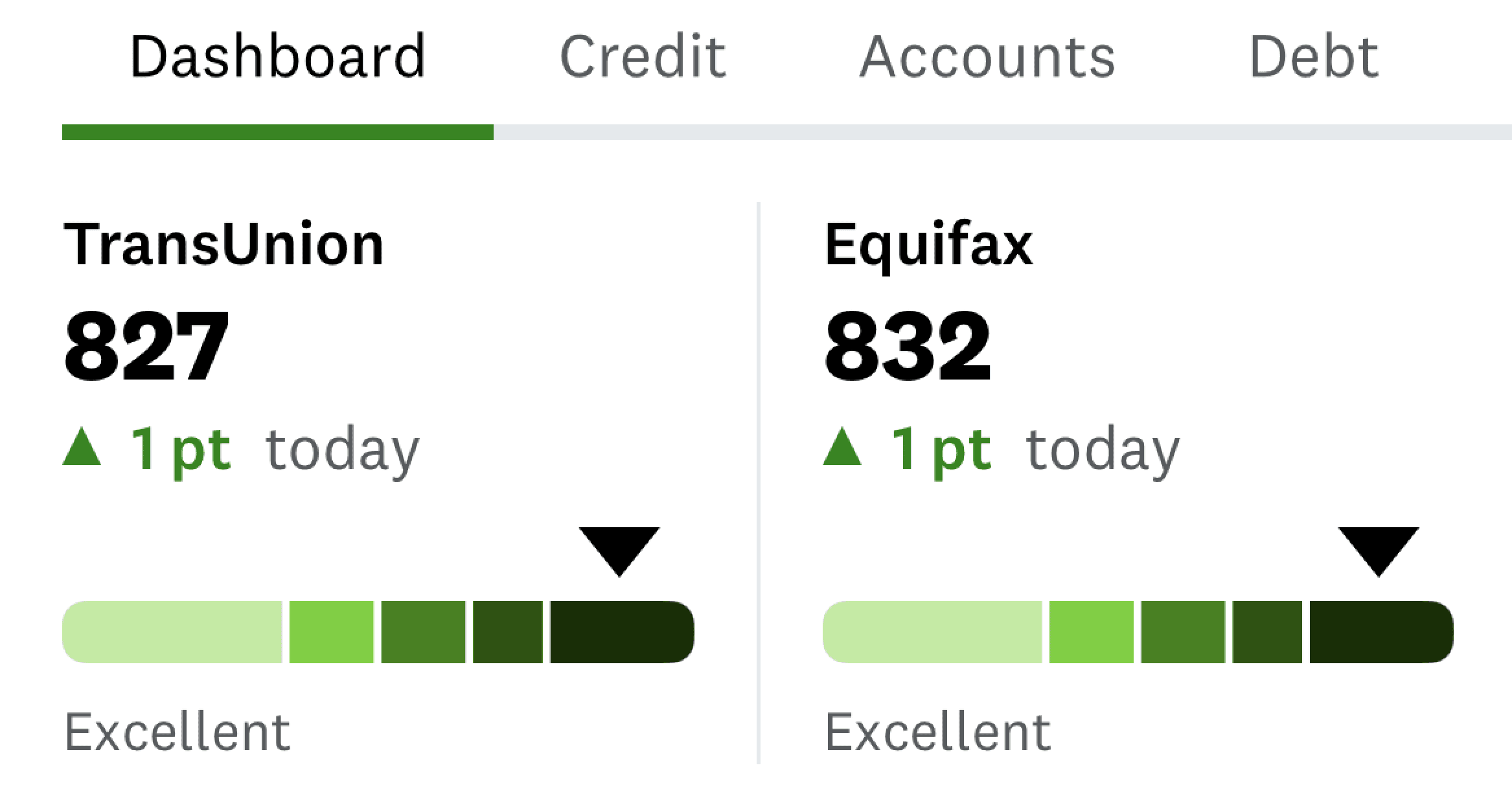
My credit score today
Let's see, what is the catch?
Not everything is rosy… There is a very clear reason why credit card issuers (aka banks) are so generous with the points and miles they offer: they make much more money through interest, interchange fees (which the consumer does not pay directly), commissions, and late fees than they give out in rewards.
By paying interest, we eliminate any benefit we can get from credit cards. The only way to truly get a benefit is by paying the full balance of your credit cards each month.
Therefore, the golden rule of this hobby is not to spend more than we can afford to pay month to month so that we do not pay interest on our purchases.
If you are someone who is not responsible with your credit cards, spends more than you can afford to pay each month, and is prone to falling into debt, we do not recommend using credit cards until you change your financial habits. That is the first step.
So, how do points and miles work?
Airlines and hotels have their own loyalty programs that reward you with points when you fly or stay with them.
At the same time, banks have partnerships with many of these airlines and hotels, making it possible to earn points and miles through their credit cards.
These points can be redeemed for flights, hotel stays, upgrades, and much more.
Some cards earn points and miles directly from the hotel or airline, and other cards earn flexible points, which are points that we can transfer to hotel and airline loyalty programs. Tip: Cards that offer flexible points are the priority.
Using the points
Once you have accumulated a considerable amount of points, it's time to use them. Ideally, in the most strategic way possible.
As we said, there are different ways to redeem our points and some can be better than others. It is not always obvious which redemptions offer the best value and it can be confusing at first, so it is important to familiarize yourself with the main rewards programs, the different currencies, and understand the differences between cash back, flexible points, non-flexible points, and miles. You know, you're going to want to focus primarily on flexible points.
There is a learning curve to understanding what represents a good value and what doesn't, but once you learn it, it's a before and after in the way you look at credit card rewards.
You will realize very quickly that an economy class flight for 50,000 miles is usually not a good redemption when it costs $500 in cash, while 60,000 miles for a business class or first class flight that would cost more than $4,000 in cash can be excellent.

Traveling from Germany to the United States in business class for just 60,000 miles and $150
Is traveling with points and miles for you?
This hobby is amazing. It has allowed us to take trips that we never in our lives thought were possible, but as we said, it has a golden rule: never spend more than you can afford to pay in full each month.
If you can follow this rule to the letter, are organized with your finances, and love to travel (who doesn't?), this hobby is for you.
First Steps to Get Started
Define Your Travel Goal
Remember that this requires knowledge and strategy. Before you start applying for cards, think about:
✔︎ Where do you want to travel?
✔︎ Do you know which airlines fly to that destination or how you can get there?
✔︎ Do you want a luxury experience or are you looking for budget-friendly options?
✔︎ Approximately how many points will you need for your trip?
If you have a clear destination, you can choose cards that maximize your benefits according to your plans, such as airline-specific or hotel-brand cards, though the main priority should be flexible points to have greater flexibility, as these can be transferred to different airlines and hotels, meaning you are not tied to a single airline or hotel chain, and you have many more options to choose from and plan your trips better.
If you do not have a defined plan and are more of a "go with the flow" person, implementing what you learn as you accumulate points, the best way to start is with cards that offer flexible points.
Some of the best starter cards that offer flexible points are:
💳 Chase Sapphire Preferred® Card
The best card to get started in the Chase Ultimate Rewards points ecosystem.
💳 Capital One® Venture® Rewards Credit Card
Earns Capital One Miles and offers a simple reward structure with a very competitive welcome bonus.
💳 Citi Strata Premier℠
Offers one of the best reward structures for cards in this category, and is necessary for the ThankYou® Rewards ecosystem.
💳 Bilt Mastercard®
Allows you to earn points on residential rent or HOA payments without incurring additional transaction fees. It is currently the only card in the Bilt Rewards ecosystem.
But I don't like cards with annual fees…
Many of the cards with the best benefits that will allow us to accumulate hundreds of thousands of points or miles have an annual cost. These costs usually range from $95 to $250 for mid-tier cards, and premium cards usually range between $325 and $999.
It may seem counterintuitive to pay for a credit card to save money on travel; however, many of these cards offer benefits that can justify the cost for many people. These benefits include travel credits, free hotel stays, airport lounge access, complimentary status with certain hotels, and much more.
The important thing here is 1) not to overpay in annual fees unnecessarily, and 2) to analyze if the credit card is truly beneficial for us to pay that cost year after year.
If a card with an annual fee is no longer beneficial to us, there is always the option to downgrade or, in the worst-case scenario, cancel the card.
Downgrading is usually a better option than canceling, but there is nothing wrong with canceling if it is done correctly
Once You Master the Basics
Once you master the basics, you will notice that there are many details that go beyond credit cards but are part of this hobby, such as strategies to earn more points outside of cards, status levels with hotels and airlines, alliances between airlines, "sweet spots," and much, much more.
We always say that this can be the most rewarding, entertaining, educational, and enjoyable hobby, and if you want to learn how to make it a reality, we are sure that the content on this blog and other resources will support you throughout the journey.
To Wrap It Up
Earning and using credit card points and miles effectively can seem overwhelming and confusing at first, and we are not going to lie. It is!
We spent months, literally, trying to figure out how the whole dynamic worked because everything seemed too advanced and we didn't understand many things, until gradually we started catching on, implementing it, and learning from our own experiences.
Our goal is to help everyone who wants to start traveling much more, in whichever way they want, without having to spend months of intense work like we did.
Now that you have the basics, we want to teach you how to travel almost for free using points and miles so you can visit all the destinations you have always wanted, without burning through your savings along the way.
💬 Frequently Asked Questions
I don't live in the United States, can I travel with points?
Living in the United States gives a big advantage for this hobby, but it is not necessary. What is necessary is having access to the country's banking and credit system, and this can be achieved by obtaining an ITIN (Individual Taxpayer Identification Number for foreigners).
You can click here for more information on how to obtain an ITIN and access the USA banking system without living in the United States.
Do I need good credit?
To qualify for most credit cards that are useful for accumulating points and miles, you need good credit. We recommend having at least 670 points to start, and starting with basic cards that have a higher probability of approval for people who are just beginning their credit history or do not have a score considered excellent.
How can I get business credit cards?
You can see our guide about this here.
Can I do this with my partner?
Not only can you do this hobby with your partner, but we recommend it 100%. It is one of the best ways to accumulate double the points and miles and alternate between strategies.
Do I need to spend a lot of money to accumulate points?
No, but it is a reality that the higher your expenses, the more points you can accumulate.
A person with average monthly expenses of $2,000 is enough to be able to take advantage of this hobby.
If your monthly expenses are $3,000 or more, you have the advantage of being able to accumulate many more points and access more strategies.
If you have a business, especially one that deals with inventory, you have a huge opportunity to benefit from credit card points.
Is this legal? It sounds too good to be true
Completely legal and widely accepted. There are rules that must be followed if we want to make this hobby sustainable over time, as banks are not in the business of giving away rewards. If you do not follow the rules and/or abuse the system, banks may close your accounts and cards. This is what you most want to avoid.
What is the best card to accumulate points and miles?
There is no single best card for everyone because we all have different situations, however, there are some that we consider the overall best cards for traveling with points and miles. You can find them here.
Do points expire?
The validity of points varies from program to program. Usually, credit card points never expire, as long as the account remains open (there are always exceptions). Hotel and airline points have very different rules from each other; some never expire and others expire after a certain period without account activity. You have to familiarize yourself with each program so that you are not caught by surprise and end up losing your points due to inactivity.





More from 2 with Points




Advertiser Disclosure: Endeuda2 has partnered with CardRatings for our coverage of credit card products. Endeuda2 and CardRatings may receive a commission from card issuers. Some or all of the card offers that appear on this website are from advertisers. Compensation may affect how and where credit card products appear on this website. This website does not include all card companies or all card offers available.
Editorial Disclosure: The opinions, reviews, analyses, and recommendations are solely those of the author and have not been reviewed, endorsed, or approved by any of these entities.