

The three pillars of healthy personal finances can be summarized as: staying away from toxic debt, saving a percentage of our income, and investing consistently.
Sounds easy, right? Although in practice it is usually not that simple for most people, either because they never learned how to manage and administer their money the right way, they made poor economic decisions, they went through difficult times and had to resort to debt, or many other reasons. Personal finances are a whole world and individual situations are completely different from person to person, and each one of them is its own reality.
Imagine this scene: you are determined to build your wealth and secure a stable financial future through investing, but at the same time, you are carrying debt. This situation raises a crucial question: Should you pay off your debts before investing, or would it be better to invest while paying off your debts little by little?
Since every situation is unique, it is difficult to answer precisely without knowing the details. Especially because it largely depends on the type of debt and the amount you have, as well as each person's investment profile. However, there are certain parameters that can help us define what decision to make and what benefits us the most.
First things first
Regardless of our case, there are indeed a couple of "rules" to follow even before determining whether we are going to prioritize paying off our debts or investing, and this includes having a security/emergency fund of between 3 and 6 months of fixed expenses, and getting rid of all credit card debt.
Yes, credit card debt does not even enter into the "get out of debt or invest" equation, because it will never be beneficial for a person to carry a balance on credit cards, even if they are very aggressive at investing.
This is because credit card interest rates are so high that no investment is going to give us a return higher than them, and consequently we would be effectively losing money. If your credit card has an interest rate of 27% and your investments had an extraordinary return of 20% (which is not normal), you are effectively losing 7%.
Regarding our emergency fund, the amount of money will depend on our particular situation. If we have children or other dependents, if our income is not predictable or stable, or if we have an unstable situation in general, we will want to be a bit more conservative and have at least 6 months of fixed expenses saved.
But if our situation is somewhat more predictable, our income is very stable and we have no dependents, we can feel secure with about 3 months and from there prioritize other goals, such as debt payment and investing.
So, before we consider starting to invest or getting out of debt beyond credit cards, it is mandatory to have some savings for our tranquility and peace of mind. You would be shocked to know how many people have shared horror stories with us and how an unexpected event radically worsened their financial situation, and months or even years later they have not been able to recover due to the level of debt incurred and their respective interest. Life comes with many surprises, and it is up to us to be prepared for them.
After having these two points ready, that is when we can begin to analyze our own situation to determine if we should get out of our debts or invest (more than what we are doing).
The type of debt and your investment profile
Assuming we already have our tranquility, security, emergency fund (or whatever you want to call it) and that we do not have credit card debt, it is time to define whether it is better to settle the rest of the debts we have or invest.
For this, we must know the type of debt we have and the interest of each one, as well as our investment profile. Why? Because these two factors are what will determine if we should do one thing or the other.
In general terms, if the interest on our debts is lower than the return we can expect in the long term from our investments, it is better to invest instead of getting out of debt.
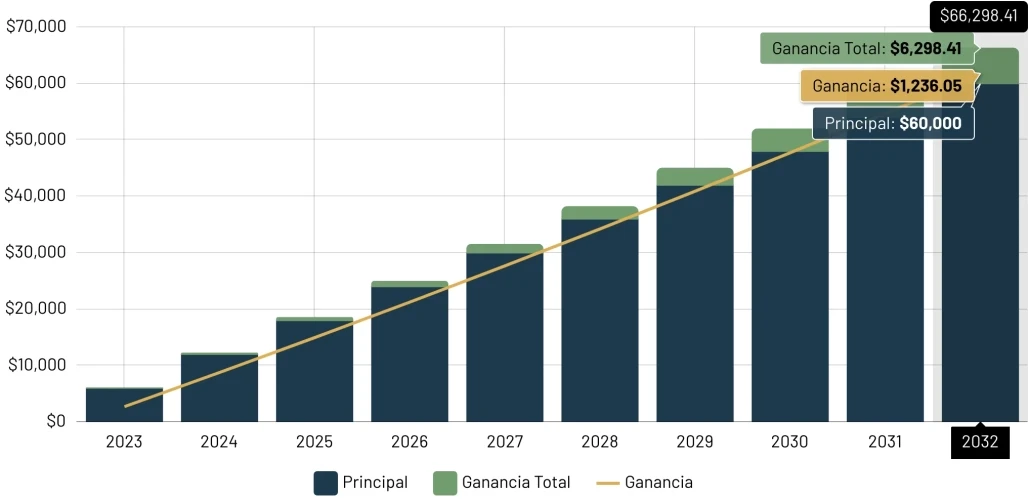
For example, if our investment profile is moderate and we expect a long-term compound annual return of around 6% net (which is in line with this profile), it would make sense to focus on paying off our debts that exceed that return.
If we have a car loan with an annual interest rate of 9%, it is best to prioritize paying it off and then focus on investing. This does not mean completely stopping investing to pay off our car, as time is the most important factor in our investments, but rather shifting the dynamic slightly in the priority of our actions for our own benefit.
If we pay $400 a month on our car loan and we are investing $300 in our retirement account (like a 401k or an IRA) and $200 in a regular investment account, it may be prudent to continue with our retirement investments, but all the additional money that is now going to investment should be directed to paying off our car and getting out of that as soon as possible since in the long run we will have a better return on our money.
On the other hand, if we have a student loan debt at an annual rate of 4%, it may be convenient to pay it under the original plan and prioritize investing, since over the life of the loan we will be able to obtain a net benefit of around 2% compound annually, which can have an important impact after several years.
Now, if our investment profile is conservative and we are close to reaching retirement age or are in the midst of retirement, it is normal that we want to get out of the debts we have faster, even though they have lower interest rates. Although in an ideal world, if we are close to retirement age, at this point we should not have any type of debt.
But if we have an aggressive profile and a time horizon of more than a decade, and in turn we have a loan whose interest rate is 9% annually, it could be a better financial decision to continue investing as we pay off the loan. And we want to emphasize "could", because in investments there are no guaranteed returns. It is possible that we could get a better return by investing, but there is no guarantee of that.
This is when we must also weigh other factors such as the probability of success of our long-term investments, which should be quite high if we invest the right way, as well as the psychological effect that taking one path or the other would have on us.
If the loan had an interest rate of over 10%, the best decision is to prioritize paying it off.
On the other hand, if we talk about debt as an investment, such as hipothecary loans (mortgages) on properties, it may be financially prudent to want to keep this debt for as long as possible as they are paid off on their own through rents, and use our own money to continue investing.
It is worth noting that there usually comes a point where people want to finish paying off all debts, despite it not being "the best financial decision", and we are going to see why in a moment.
Stop contributing to my 401(k)?
Saving and investing for our retirement is something we should start doing as soon as possible, and for most employed people, the most direct path to this is through a 401(k).
If we are contributing to our 401(k) and our employer offers us a "match", we should consider continuing to contribute despite barely starting our emergency fund or if we are in the middle of a plan to settle debts (including credit card debts).
This is because by having a "match" from our employer, we are getting a 100% return immediately on our money without counting the potential for long-term growth, and this is a return that not even credit card debt can beat.
If our employer provides us with a 100% "match" on up to 3% of our contributions, it is worth allocating that 3% of our income to our 401(k) and receiving an additional 3%. That is an instant 100% return on our money.
Beyond that, we must focus on building our emergency fund and paying off our credit card debts.
The psychological benefit of getting out of debt
Although at a financial level there always tends to be one decision better than another, one of the biggest reasons to prioritize getting out of debt instead of investing is the peace of mind and peacefulness this represents.
It is very possible to use debt as a leverage tool and that in the future it will help us generate more money; but like everything, this carries its risks. There is no 100% risk-free leverage and for the most part, the people who "have lost everything" in financial crises have done so as a result of leverage.
It is not the same to have 10 houses and actually own only 10% of each one, as to have 3 and own them 100%; the risk is incomparable. In the event of a crisis or things not going well, the person who owns 100% of the property has much more flexibility.
Of course, it is easier to own 10% of 10 houses than 100% of 3, and they can give you similar results. That is why leverage is so attractive and can work very well.
But it is a fact that we do not all have the same risk management or tolerance. This is why, despite being a better financial decision to keep debt until the last possible moment and invest in parallel, there are those who prefer to get out of debt 100% for reasons of peace of mind and to be able to sleep better at night. It is impossible to put a price on this and it is a completely personal decision.
Conclusion
Each person has different types of debt, investment profiles, time horizons, personal situations, and goals, and therefore, it is necessary to make an analysis of one's own to make an appropriate decision regarding our own situation, and thus be able to determine whether it is more convenient to prioritize getting out of debt or investing more. The most important thing is that you are making an informed decision and that you know it is the right one for you.
That being said, the foundations of personal finance are the same for the vast majority of people. So regardless of the case, everyone's highest priority should be to have a solid emergency/security fund, keep completely away from credit card debt and similar products, and start investing for our retirement as soon as possible.



More Posts